
Settling in at daycare (Kita) – Everything you need to know
 Arianne Vogt
Settling in at Kita: The complete overview

In short: A gentle Kita settling-in period is the foundation of your child’s time in care. Here you’ll learn how to be a safe haven and support the transition without time pressure or unnecessary stress.
🧭 Navigation & terminology
Contents:
- Why it matters
- Types & models compared
- Step-by-step process
- Perspectives, myths & expert check
- Strategic pros & cons
- FAQ & decision support
Key terms:
- Safe haven: In attachment theory, the role of parents (and later the key person) from which the child sets out to explore and to which they return when unsure.
- Transitional object: A familiar item from home—a cuddly toy or comforter—that gives the child comfort and a sense of security in the new setting.
1. Why gentle Kita settling-in matters more than ever
Starting daycare or nursery is an emotional milestone. It is often the first time a child is away from their primary caregivers for longer stretches. Attachment-aware settling-in is essential for families with infants and preschoolers: it lays the groundwork for the whole Kita experience. When the transition is shaped with empathy and respect for the child’s needs, they can build deep trust in the world beyond the family.
How practice has evolved
Thankfully, the days of tearful handovers at the gate on day one are largely over. Modern early-years education draws on models such as the Berlin settling-in approach. Current practice also stresses a close parent–educator partnership between home and staff. Many centres additionally use outdoor and natural spaces to support exploration and to ease stress that often comes with new situations.
Settling in at daycare (Kita): Settling in at daycare helps your child move into their new routine with sensitivity—the guide below offers practical tips for a needs-led, gentle preparation and support when care begins. More on settling in at daycare – including seven tips for a gentle start.
2. Types of settling-in compared
Understanding different approaches helps you grasp your centre’s philosophy. The table shows common models in practice.
Good to know: Nature-focused Kitas usually build on the same psychological structure as established models and add an outdoor setting.
| Model / type | Focus / audience | Main advantage | Complexity |
|---|---|---|---|
| Berlin model | Building attachment to a fixed key person | Clear structure, highly responsive to the child’s cues | Medium |
| Munich model | Early integration into the whole peer group | Supports social interaction and peer relationships from the start | Medium |
| Nature-based settling-in (e.g. Berlin-based) | Toddlers who benefit from calmer urban green space | Combines a proven attachment structure with a lower-stimulus environment | High (needs a suitable Kita profile) |
3. Step by step: The standard process
A systematic, sensitive Kita settling-in process supports your child’s wellbeing and reduces the risk of severe separation anxiety.
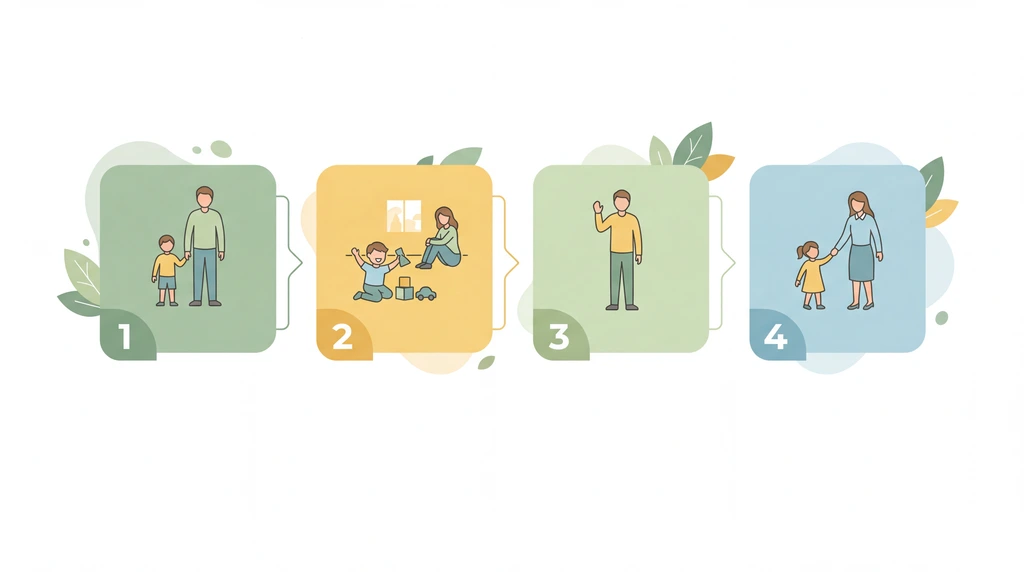 Caption: The path to secure attachment: the four classic phases of attachment-aware settling-in at a glance.
- Quick checklist for Kita start:
- 4–6 weeks at work blocked (leave / flexible hours)
- Plan with partner (who covers which days and sudden illness?)
- Transitional object (toy / comforter) chosen and packed
- Mud trousers & wellies (for you too if you join outdoors)
- Preparation & partnership: A first meeting between parents and the future key person builds trust. Routines, rituals, and your child’s individual needs are discussed.
- Base phase (days 1–3): You stay with your child in the setting for about one to two hours. Your role: present but passive. You are the safe haven. You don’t push play with others; you let your child explore at their own pace.
- First separation & stabilisation: Only around day 4 or 5 (not on a Monday), a short, planned separation of 10–30 minutes takes place. Your child’s response shapes the length of stabilisation. If the key person can comfort them, separation time increases gradually.
- Final phase & handover: Parents no longer stay on site but stay reachable by phone. The educator has successfully become the child’s secure base in the setting.
Watch out: time pressure takes a toll: The biggest threat to a stable bond is not having enough time. Block out 4–6 weeks for settling-in when you can be as flexible as possible at work. Ending the process too early because of job pressure often leads to major setbacks.
4. Perspectives, myths & expert check
First experiences of non-parental care stir strong myths that can unsettle parents unnecessarily.
Approaches in practice
- Attachment-led: The child’s pace rules. If they are inconsolable at the first separation attempt, the separation stops and a gentler try follows the next day.
- Nature-led (Stadtküken): Uses the Berlin structure but moves early getting-to-know moments outdoors. Open, calmer green space can reduce noise and spark curiosity.
Myth vs. fact
❌ Myth: The longer I drag out goodbye in the morning and cuddle, the easier separation becomes.
✔ Fact: The opposite is true. Short, clear, loving goodbye rituals build security. Dragging it out signals your own anxiety and can increase separation anxiety.
❌ Myth: If my child cries at handover, settling-in has failed.
✔ Fact: Crying is a normal, healthy response to leaving the safe haven. Success is not “no tears” but whether the child can be comforted quickly by the new key person.
5. Strategic pros & cons of gentle settling-in
Here we weigh what a multi-week, attachment-aware process means so you can prepare realistically.
✅ Advantages:
- Secondary attachment: Your child builds a real relationship with a professional—supporting resilience and readiness to learn long term.
- Lower stress: Individual pacing (and sometimes nature) helps keep stress hormones in check.
- Trust: Clear goodbyes help your child trust that you will return.
❌ Challenges:
- Time: Often 4–6 weeks need real flexibility at work and at home.
- Emotional load: Staying back and “letting go” can be hard for parents.
💬 Expert voice: “Settling-in isn’t an annoying chore—it’s the emotional foundation for the whole Kita years. If we give children the time they need and, as a team, use the calming effect of nature to reduce stress, we build deep, trusting partnership between Kita, child, and family.” – Arianne Vogt
FAQ: Common questions about Kita settling-in
How long does settling-in usually take?
Typically 4–6 weeks. Every child is different. Illness (very common in the first weeks) or a disrupted weekend can extend the process—plan buffer time.
👉 Tip: Agree with your employer (e.g. home office, using overtime) so you can stay available through stabilisation without constant time pressure.
How should I behave in the first days as a parent? Stay rather passive and pick a fixed spot at the edge of the room. You are the safe haven your child can return to. Read or watch kindly, but don’t push them to play—that first contact should come from the new key person.
What if my child cannot be calmed at all? If strong separation anxiety appears and staff cannot soothe them, the separation is paused. In partnership with the team you usually step back: extend the base phase to strengthen the bond with the key person before trying separation again.
👤 About the author
Arianne Vogt is a member of the press team at Stadtküken (Die Natur-Kita) in Hamburg. She prepares editorial content on early childhood education, outdoor pedagogy, and everyday Kita life, with a focus on clear language, practical relevance, and professional consistency.
Editorial note: This article has been reviewed for accuracy, up-to-date attachment thinking, and alignment with common pedagogical guidance.
Sources & further reading
- infans (Institute for Applied Socialisation Research / Early Childhood) – the Berlin settling-in model
- State Institute for Early Childhood Pedagogy (IFP) – attachment theory and the Munich settling-in model