
Hamburg Kita voucher calculator – Everything you need to know
 Arianne Vogt
Hamburg Kita voucher calculator: The complete overview

In short: Hamburg’s Kita voucher calculator helps you estimate your parent contribution from the 6th hour onward—so you can plan monthly costs with less stress.
🧭 Navigation & terminology
Contents:
- Why it matters
- Types of Kita costs compared
- Step-by-step use
- Perspectives, myths & expert check
- Strategic pros & cons
- FAQ & decision support
Key terms:
- Adjusted net income (bereinigtes Nettoeinkommen): Monthly household income minus certain statutory allowances and work-related deductions—used as the basis for Kita fees in Hamburg.
- Sibling discount: In Hamburg’s system, the second and each further child in care usually pays much lower fees or none for the same type of charge.
1. Why the Kita voucher calculator matters more than ever
For Hamburg parents and parents-to-be, financial clarity is crucial. Stadtküken’s built-in Kita voucher calculator reflects Hamburg’s fee rules and helps you build a reliable household budget. Because costs depend heavily on your situation, calculating early avoids nasty surprises when you choose childcare—including at Stadtküken.
How fees have evolved
Rigid old tables confused many families. Today’s income bands under Hamburg’s fee schedule aim at social fairness. Parents increasingly want affordable core hours and strong pedagogy (e.g. outdoor programmes). A good staff-to-child ratio or extras need not be “unaffordable” if you separate standard fees from optional add-ons before you decide.
Kita voucher calculator: With our integrated Kita voucher calculator you can quickly estimate your likely parent contribution. Hamburg scales costs by household income, number of children in the household, and hours booked—the tool supports budget planning for a Stadtküken place. Enter your details to see the monthly impact. Open the Kita voucher calculator
2. Types of Kita costs compared
Understanding cost blocks helps you plan.
| Model / type | Focus / audience | Main advantage | Calculation complexity |
|---|---|---|---|
| Core care (5 hours) | All parents (legal entitlement) | €0 parent fee for care (meals may apply) | Low |
| Extended care (6–12 h) | Working parents, students | Income-based, fair bands | Medium (income check) |
| Profile Kitas (extras) | Parents wanting special pedagogy (e.g. organic food) | High quality, extras shown separately | High (calculator + centre-specific fees) |
3. Step by step: Using the calculator
A systematic approach improves planning and reduces risk.
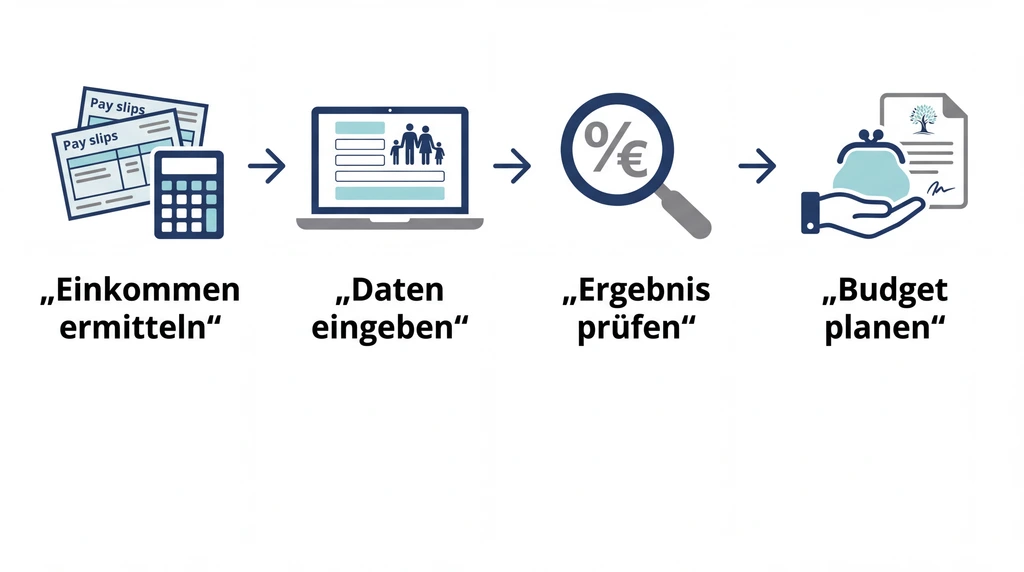 Caption: Four steps to a reliable fee picture—from income to your estimated share.
Incomplete data is expensive: Enter the correct household size (people in the household). If you forget siblings, the tool may show a much higher fee because allowances are missing.
- Preparation & figures: Before you open the calculator on stadtkueken.de, gather solid income figures—guesses often backfire.
- Document quick list:
- Payslips, last 12 months, both parents where relevant
- Replacement income (parental allowance, unemployment benefit)
- Self-employed: latest tax assessment or current accounts (profit estimate)
- Document quick list:
- What to enter: Your adjusted net income and desired hours (e.g. 8). Use the sibling discount: tick if other children are in funded care. Low-income households may hit a minimum charge or hardship rules.
- Reading the result: Check the output critically. Fee-free check: the first 5 hours of care should show €0 parent fee for care; you pay for extra hours (and possibly meals).
- Profile extras: The calculator covers Hamburg-regulated care fees and the usual meal charge. Voluntary extras (e.g. extended organic meals, trips) ask your preferred setting and add them on top for a full picture.
4. Perspectives, myths & expert check
Fee rules invite myths.
Approaches in practice
- Whole picture: Parents calculate early, note the maximum band, and budget voluntary profile extras.
- Patchy: Parents rely on hearsay, forget household size, then are shocked by the official bill.
Myth vs. fact
❌ Myth: A second child in Kita doubles our monthly bill.
✔ Fact: Hamburg’s sibling discount sharply reduces fees for the second and further children in care.
❌ Myth: Profile and nature Kitas are only for high earners.
✔ Fact: The base Kita fee is income-based. Profile centres add moderate voluntary extras (e.g. organic food), so many income levels can still access them.
5. Strategic pros & cons
How to use the tool well for family decisions.
✅ Advantages:
- Planning: You see your likely own share months before the start.
- Transparency: Fee-free first 5 hours vs paid extra hours is clear.
- Fairness: The tool reflects hardship rules and exact household size.
❌ Challenges:
- Income prep: Working out adjusted net income correctly takes effort.
- Extras blind spot: Voluntary centre fees (e.g. nature programme add-ons) must be asked and added outside the core calculator.
💬 Expert voice: “Modern Kita organisations need financial transparency. Our Kita voucher calculator reduces fear of unknown costs. It shows that even centres with strong organic food and outdoor profiles stay reachable for middle-income families when base fees are income-scaled—if you plan early and plan right.” – Arianne Vogt
FAQ: Kita voucher calculator
How do I “calculate” the first 5 hours in Hamburg? The first five hours (core care) are fee-free from birth. In Stadtküken’s calculator that shows as €0 parent fee for care. A statutory meal charge may still apply unless the centre agrees otherwise.
What does care beyond 5 hours cost?
The amount is individual. It follows Hamburg’s fee schedule and depends on income, hours, and children in the household. At low income, the minimum charge may cover little beyond lunch.
👉 Tip: Use the Stadtküken Kita voucher calculator on stadtkueken.de—aligned with Hamburg’s rules and your inputs for a Stadtküken place.
Must I expect extra costs at profile or nature Kitas? Possibly. Centres like Stadtküken may offer voluntary services—e.g. full organic catering or weekly nature trips. These are separate from the regulated parent fee and are agreed directly with the Kita.
👤 About the author
Arianne Vogt is a member of the press team at Stadtküken (Die Natur-Kita) in Hamburg. She prepares editorial content on early childhood education, outdoor pedagogy, and everyday Kita life, with a focus on clear language, practical relevance, and professional consistency.
Editorial note: This article has been reviewed for factual accuracy and currency.
Sources & further reading
- Hamburg Childcare Act (KiBeG) and current Hamburg fee schedule for daycare
- Official service portal of the Free and Hanseatic City of Hamburg (social authority)